More Data Isn't the Answer. Your Genes Are.

Tony Hsu · Chief Executive Officer
Nov 17, 2026 · 3 min read
Peter Diamandis published a sharp piece last week, Continuous Blood Markers: The Future of AI-Driven Healthcare. His argument: a once-a-year blood draw is like judging a movie from a few random frames. Within a few years, a patch on your arm will read your hormones, metabolism, and inflammation every few minutes and stream it all to your AI.
I agree with the direction. Glucose has already made the jump from prescription device to over-the-counter product, and hormones and inflammation are next.
But one detail stopped me. The article mentions DNA several times, only as a synthetic sensing tag inside the device. The DNA that matters most, yours, never enters the conversation. That gap is the story of this entire category right now.
The race to own your health data
Competition in this space is fierce. Blood testing companies are expanding their panels and lowering their prices. Wearable companies are building platforms where you can upload your lab results alongside your sleep, HRV, activity, and glucose data. Everyone wants to be the one dashboard for your health.
The promise is compelling: every relevant data point in one place, with AI turning it into insight.
Insight is not action
Here is the problem. Most of these platforms stop at observation. Your hsCRP is elevated. Your HRV dipped. Your sleep score fell. That is a status report, not a plan.
A trend line does not tell you what to eat tomorrow, which nutrients your body needs more of, or how to train this week. Very few platforms close that gap and deliver insights you can act on.
Action is not personalization
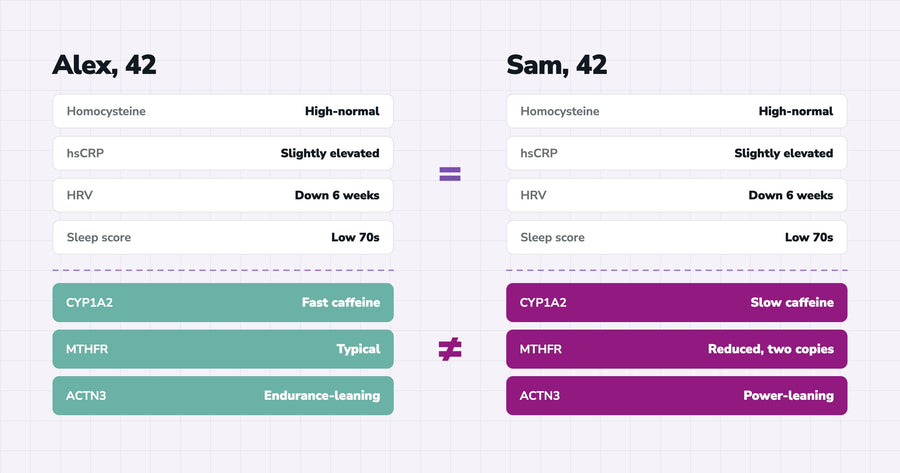
The few that do offer recommendations share a blind spot. Their engines are population-based: marker X is out of range, so here is standard advice Y. Two people with the same lab value get the same playbook.
The same number can come from very different biology. Take two people with elevated homocysteine. One carries MTHFR variants that change how they process folate, so the form of folate they take matters. The other does not. Same marker, different body, different answer. Generic advice serves one of them well and the other one poorly.
That is not personalization. That is segmentation.
The missing foundation
Blood markers and wearables tell you what is happening. Genetics tells you why, and how your body is built to respond.
Your genome is the one layer of your health data that does not change. It is the baseline every other measurement should be read against. Continuous biomarkers measure the output. Your genes are the input. Leave them out, and AI is interpreting the movie without knowing the characters.
This is arguably the most significant part of the foundational equation, and not one of these platforms incorporates it today.
Genes first, then everything else
Only when you incorporate someone's genetics do the recommendations become truly tailored to the individual. Not "people with your lab results" but you: how you metabolize nutrients, handle stress, recover from training, and respond to the food on your plate.
That matters because outcomes are won on follow-through. Guidance that fits your biology is guidance that works with your body instead of against it, and guidance people can see themselves in is guidance they stick with.
This is why we built 3X4 around a Genes First™ framework. Continuous blood data will be a powerful layer. But it is a layer. The foundation is your DNA.
The future Peter describes is coming fast. More data is not the finish line. Continuous markers tell you where you are. Your genes tell you how to get where you want to go.